

PEACE AS ENDURANCE
How does one go about creating a culture of peace when we grow up inside social systems we did not author that are often violent or unfair? In this episode, we hear from Beah Batakou — a poet and attorney based in Accra, Ghana. Peace making requires qualities that she learned from her mother and grandmother like “steadiness” and “strategic calm.” For Batakou, creating an inheritance of peace means transforming survival into structures for flourishing, and having the disciplined endurance to bring them into life. Let’s jump right to learn more.
Beah Batakou (BB): I consider myself to be a woman of many faces — something of a jack-of-all-trades.
Amy Shimshon-Santo (AS²): And a master of many.


BB: I consider myself a dual cultivator, particularly in relation to my professional life. I am a lawyer by profession and I am also a poet. I cultivate both practices simultaneously, always trying to understand how poetry weaves into the law, and how the law in turn, intersects with poetry.
Beyond my professions, I am also both Beninese and Ghanaian. I rarely identify myself as simply Ghanaian, even though that is the orthodox expectation where I come from. In my community, lineage is patrilineal, so people often say that you belong to your father’s family. But I was not raised by my father’s people. I was raised by my mother and her family. And the world I grew up in carries many influences that are not strictly Ghanaian. Because of that, I cannot confidently say I am only Ghanaian. I am also Beninese, and that heritage has shaped me in important ways. Before colonial borders were drawn we were part of a continuous cultural space anyway. Despite differences in ethnicity and tribe, people lived within overlapping worlds and shared practices, so the distinction has never felt absolute to me.
Much of my work, both as a lawyer and as a poet, is concerned with inheritance. I often write about spiritual inheritance, cultural inheritance, political inheritance, and bodily inheritance.
I come from countries that have been shaped by trade, by missionary presence, and by colonial administration. At the same time, they have also been shaped by resilience and by the quiet labor of ordinary domestic life. My writing, and even my practice of the law, sits at that convergence.
“I come from countries that have been shaped by trade, by missionary presence, and by colonial administration. At the same time, they have also been shaped by resilience and by the quiet labor of ordinary domestic life. I try to understand what it means to grow up within these pillars of society, and to develop a language capable of interrogating them without flattening their complexity.”
I have always been interested in what it means to grow up within systems that existed long before you arrived. Many of my poems engage with Catholicism, gender, and economic constraint. I often speak about gendered expectations, religious systems, and poverty—about the structures that shape everyday life. I try to understand what it means to grow up within these pillars of society, and to develop a language capable of interrogating them without flattening their complexity.
I also have a deep affection for what I call chaos, though I do not mean it negatively. I think of chaos the way one might look at a child’s scribbles. There is a kind of beauty in that disorder. It is a convolution of things that do not neatly fit together, and I find that compelling. For me, that kind of chaos represents tension. I often feel a surge of joy when I can inhabit that tension and create something from it.
Growing up, I was very much a church girl. My childhood was shaped by catechism, rosaries, and prayer camps. At the same time, I grew up aware that these structures often carry violence alongside the comfort and solace they provide.
Despite that, I was raised by very strong women—my mother and my maternal grandmother. Their endurance was not always described as strength, and the things they survived are not experiences we would ordinarily romanticize. But I see their lives as a form of profound endurance, and that is the strength I recognize in them.
My life has also been shaped by place—by the sea, by heat, by dust, by classrooms and offices. All of those textures find their way into my poems. In some ways, they also find their way into my legal writing.
Since last year, I have become increasingly attentive to the idea of the body as an archive. The manuscript I worked on at the Watermill Center in New York explored this. I was trying to understand what it means to think of the body as something that stores history, how trauma and devotion leave inscriptions on flesh, and how memory and experience travel across generations through the body itself.
In many ways, I see myself as someone trying to reconcile reverence and rebellion within the same breath.
AS²: There’s so much happening in what you’re describing. I was also raised at a kind of crossroads — between legal ideas of justice, the frameworks societies create to keep people safe, to establish precedents, and to organize collective life — and the artistic space which is deeply concerned with culture-making. Even though I come from a different part of the world, your language of reverence and rebellion feels very legible to me. So does your affection for chaos. Sometimes things do need to be shaken up. Not in a destructive way, but in a way that reveals where power sits and how it operates. Your work seems to do that—pointing toward power from different angles. And you’re clearly not owned by anyone but yourself.
My second question is this: how do you spend your life force? What kinds of things occupy your time and energy?
BB: Yes, definitely. When you mentioned “life force,” the first word that came to mind was ambition. But I don’t really think of life force as ambition. This year especially, I’ve found myself in spaces where people say, “You come across as a very ambitious person. How do you do that?” And the truth is, I’ve never really thought of myself that way. I tend to think more in terms of energy, or force.
When I reflect on what I get to do with my life, I think about the accumulated charge of my experiences. Those experiences didn’t break me, but they marked me. That charge includes grief, anger, discipline, faith, and a great deal of doubt. It includes desire, fatigue, and hope. When I write, those charges become legible. A lot of what flows out of me is rooted in those emotional and spiritual registers, and sometimes it might appear heavy. But I don’t consider myself a pessimistic person. If anything, my professional training—especially as a lawyer—has taught me to see what could exist but does not yet exist. That orientation naturally brings grief, anger, doubt, desire, and fatigue into my work. I tend to gather all of those forces under a larger structure that I call survival.
“I convert silence into speech. I convert confusion into image. I convert memory into form. And through that process, I also refuse simplification.”
The ability to transform expressions of survival into structure is really what my purpose is about. Many of us—especially women, and particularly women of color—inherit systems that we did not design. We inherit patriarchal authority, religious hierarchies, and economic precarity. These systems exert pressure. They shape us and, in many ways, attempt to contain us. What my work allows me to do is metabolize that pressure rather than simply carry it. I don’t want to carry that pressure unchanged. I want to transform it. What I do feels like a kind of conversion. I convert silence into speech. I convert confusion into image. I convert memory into form. And through that process, I also refuse simplification.

There’s always a temptation, especially when writing about faith or violence, to reduce things to a single narrative. To choose between condemnation and devotion. Between one side or the other. Between black and white. But the force that drives my work—the transformation of survival into structure—allows me to hold nuance. It allows me to hold reverence and critique at the same time. So I can love the ritual that raised me while still interrogating the harm embedded within it. I can love being Catholic and still say, “This is wrong. This is painful. This is what is happening.” In doing that, I’m able to honor my ancestors without romanticizing their suffering.
In many ways, this practice keeps me balanced. It’s a discipline that helps me live my life with a certain steadiness. Staying on that path requires constant revision—of my work, but also of myself. Every day I learn something new. And what I write, at any given moment, is simply the best expression of my life force that I can produce at that time.
AS²: Well, that was definitely a poetic response. There are lines throughout it that reflect a poetic mindset. At the same time, your work clearly extends beyond the page. You also run an educational organization focused on menstruation education for women and girls (@HappyMonthlies). And you stepped forward to write and contribute to a national report for the United Nations on the state of women and children. So alongside your creative writing, you are also active in the public sphere—working on women’s rights and menstrual health advocacy. In other words, your writing takes many forms. Some of it is poetry. Some of it appears as formal reports. Some of it is written as policy briefs or legal documents.
“Much of my life and work begin from a simple set of questions: What systems have we inherited? What are those systems doing to our bodies? And where do we go from here? That orientation is why my work often circles back to human rights.”
BB: Yes. I did contribute to what we call a mid-term sub-periodic review, which has since been published. The report is available on the website of the Office of the United Nations High Commissioner for Human Rights under the NGO mid-term submissions to the Universal Periodic Review. You can access it here: UPR NGOs Mid-term reports | OHCHR. If you navigate to the Ghana section on that page, you will see the reports there in full. It was a collaborative effort, and I remain grateful to everyone who contributed to the work. Beyond that, I write poetry. Much of my life and work begin from a simple set of questions: What systems have we inherited? What are those systems doing to our bodies? And where do we go from here? That orientation is why my work often circles back to human rights. Ultimately, these questions return to the human being and to dignity — human dignity, but also the dignity of the environment, and our place within the wider universe. They raise questions about our responsibilities to ourselves, to one another, and to the world around us. That is the space I write from.
AS²: Yeah.
BB: I think of myself as a woman with many outlets. There are many ways to carry a message, and the outlet itself doesn’t define the message. If you’re familiar with the Bible, the Apostle Paul once said, “To the Gentiles, I became as a Gentile; to the Jews, I became as a Jew.” I often think about my work in a similar way. To a European, I can be European. To a Ghanaian, I can be Ghanaian. What matters to me is that the message travels — that people are able to understand it, live with it, feel it, and nurture it in their own contexts.
AS²: Beautiful. When you describe yourself as a church girl, it reminds me of the time I had the opportunity to visit the Elmina Castle with you and walk through the dungeons. The architecture of that place stays with you. Beneath the castle are the dungeons where people were held during the transatlantic slave trade. Nearby are burial grounds connected to that same history. Then, within the structure itself, there is the church. And above that, the residence of the official who oversaw the entire economic system of trading human beings. What struck me most was the vertical layering of it all. The roof of the dungeon is the floor of the church. The roof of the church is the floor of the governor’s quarters — the space where the person responsible for this system lived. Standing there, you can’t ignore how those layers physically embody a certain history: faith, power, commerce, and violence literally built on top of one another. And yet, when you speak about being formed within the church, you also carry a critical awareness of those contradictions.
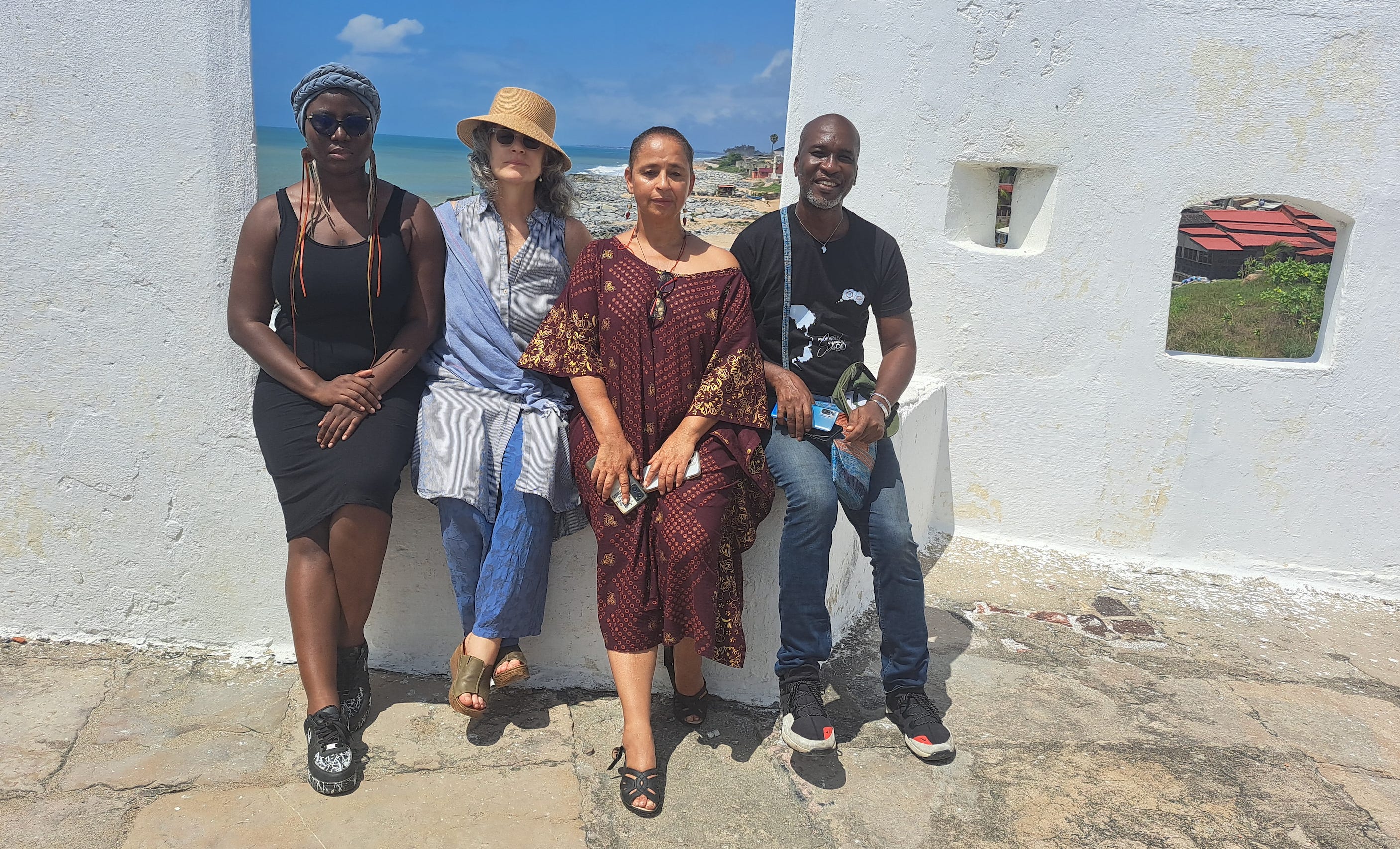
[Beah Batakou, Amy Shimshon-Santo, Phillippa Yaa de Villiers, Pelu Awofeso.]
BB: There are aspects of my faith that have been genuinely helpful — parts of it that I continue to carry with me and integrate into my life. At the same time, embracing those parts does not mean that I suspend my critical eye. I can hold gratitude for what has nourished me while still questioning and examining the structures that produced it
AS²: That sensibility feels particularly important at a moment when the world often seems intent on turning people into enemies of one another — reducing everything to a simple “me versus you.” There is a constant pressure to oversimplify human beings, to flatten our identities into opposing sides. What you’re saying pushes against that. You’re insisting on complexity. You’re saying: I am many things. I contain multiple histories, influences, and ways of speaking. I can move across spaces and communicate with different people without abandoning myself. That becomes a powerful stance against oversimplification and stereotyping. It asserts that human identity is not fixed or singular, but expansive and capable of holding many truths at once.
BB: Yeah, I remember that day at the castle. I had been there several times before, but that visit affected me differently. It struck me in a way it hadn’t before. I suddenly felt the contradiction very sharply — that the same people who came preaching salvation were also participating in the very violence their message condemned.
That memory helped clarify something about my own practice. My work is about transforming survival into structure. Those are two very different states. There is a difference between simply enduring something and actively shaping it. Many of us grow up inside frameworks we did not author. Patriarchal authority may define what a girl’s body means before she has the chance to understand it herself. Religious hierarchies may prescribe obedience before inquiry. Economic precarity can compress choice long before aspiration or ambition has the space to form. That is the kind of pressure I am referring to. It is social, moral, financial, and emotional all at once. If it remains unexamined, that pressure accumulates. It settles into the body as tension, silence, and repetition. That is what I mean by carrying pressure. When we carry it, we internalize it without altering it. It becomes posture. It becomes self-censorship. It becomes inherited scripts we perform unconsciously.
What we must do instead is metabolize that pressure. Metabolism implies transformation. The body takes something heavy or raw and converts it into usable energy. I remember you saying something like that when we left the castle—that we had to do something with what we were feeling. We asked ourselves what could be done with those emotions.
In many ways, that question shaped our conversations afterward. We began talking about how to transform those feelings into something usable, and poetry became one of the tools that allowed us to do that. Through language, lived constraints and difficult experiences could be placed into form. That is what I mean by metabolizing pressure. Once language enters the picture, the experience is no longer simply endured. It can be examined, ordered, and reframed.
“When I talk about chaos or tension, I am really describing survival. Survival rarely arrives in a neat narrative. It appears in fragments: a rule you were taught, a silence you kept, a fear you never quite named. Structure, however, is deliberate.”
When I talk about chaos or tension, I am really describing survival. Survival rarely arrives in a neat narrative. It appears in fragments: a rule you were taught, a silence you kept, a fear you never quite named. Structure, however, is deliberate. In a poem, I choose the line breaks. I decide what repeats and what is withheld. In a legal opinion, a report, or even a witness statement, I decide what belongs and what does not. I decide whether the voice is kneeling or standing—whether it speaks with authority or from a place of vulnerability. Those are formal decisions. They represent a reclaiming of agency. The experience no longer dictates the terms entirely. I do. That is what it means to convert silence into speech. Many systems—particularly hierarchical ones, including religious structures—depend on quiet compliance. Transforming silence into language disrupts that expectation.
AS²: Yes, political ones rely on that as well.
BB: Yes, exactly. In many ways, all of these systems depend on quiet compliance. What my practice — both in law and in poetry — tries to do is interrupt that quiet. But it doesn’t interrupt it by shouting indiscriminately.
I often think back to a period when I was an active protester with the Economic Fighters League. The movement has some parallels with the Economic Freedom Fighters associated with Julius Malema. In Ghana, the group organizes demonstrations and forms of resistance against what we perceive as undemocratic government decisions. At times, the strategy involved using shock value—creating disruption in order to force attention. But I also noticed that those actions were consistently labeled as illegal or indiscriminate. That labeling began to stay with me, and eventually it became one of the reasons I stepped away from that form of activism. I started to feel that language, in that context, was no longer doing the work it was meant to do. The conversation would collapse into simple accusations: this is illegal, this is reckless, this is indiscriminate. And once those labels are applied, the substance of what is being said often disappears.
“When you are able to name something precisely, you begin to move the balance of power. The terms of the conversation are no longer entirely dictated by someone else.”
That experience pushed me toward a different kind of practice—one that does not shout but articulates. One that names. Because naming shifts power. When you are able to name something precisely, you begin to move the balance of power. The terms of the conversation are no longer entirely dictated by someone else. So part of my work involves transforming confusion into image. Many of the pressures we experience are diffuse and difficult to describe. When you give them an image, you give them contour. You stabilize an experience long enough to examine it. That is what I mean by transforming survival into structure. I am not writing, or practicing law, simply to vent emotion. I am trying to organize experience into something shareable, something intelligible, something deliberate.
When people encounter my work, whether it appears as poetry, a report, or legal writing, they will often see inherited systems being held up, tested, and reconfigured. The goal is not to erase what happened, or to deny the pressures that shaped us. It is to change our relationship to those pressures. Instead of remaining subjects of those systems, we begin to interpret them. And interpretation, in itself, is a form of power.


AS²: To speak in this way reflects a kind of deep knowing. What you’re expressing comes from time, attention, and presence. It requires a sustained relationship with language, with history, with memory, and with the present moment. It also grows out of engagement with activism and lived experience.
I recognize some of that path in my own background. At one point, I believed the most direct way to improve life was through physical structures—through architecture and urbanism, through designing spaces that would simply make life more livable. But over time it became clear that power does not step aside simply because a good idea appears. There was too much abuse of power embedded in the systems themselves. Partly out of frustration, and partly from a personal need to metabolize pain, I had to confront what it actually takes to build a good life. I realized I cannot even imagine a good life, let alone live one, unless I feel some measure of power within myself.
In many ways, that is what this project is trying to address. We are acknowledging that we have been shaped by structures that are violent, oppressive, and unfair. These systems often make life harder rather than easier, especially for women, for children, for families, and for people who are outside the financial elite.
As a woman, as a mother, as a thinker, and as a creative person, I am constantly asking: How can our actions begin to generate a different reality? What can we build now that might move us toward the future we actually want? This is why it feels like the right moment to turn toward the idea of the Inheritance of Peace. The question is whether we can have the audacity to ask for a form of peace that is not passive or lethargic. Not powerless. Not complacent. But a peace that carries strength, intention, and the capacity to reshape the conditions we have inherited.
BB: Amen.
AS²: I’m really trying to co-create some kind of form that is life-giving rather than life-denying. In the United States, we’ve seen a series of high-profile killings carried out by the government. What I struggle to see is the process of what replaces a bad system once it is removed. Many people agree with the idea of getting rid of what is harmful. But there seems to be much less attention on the question of how we create the good.
I am very curious about that question of the good. I believe we wouldn’t even be here if there weren’t some inheritance of goodness, of peace, that we could build upon and give form to. And I’m wondering if you might share your sensibility about what an inheritance of peace looks like. You engage with the domestic sphere, but also with public policy, international policy, and even energy policy. So at whatever scale you wish to approach it, I’m very interested to hear how you think about this idea of an inheritance of peace.
“I come from women who carried immense responsibility without drama or theatrics. They endured scarcity. They endured silence, social pressure, and spiritual contradiction. Yet what I inherited from them was steadiness.”
BB: I often speak about an inheritance of survival. If I were to articulate an inheritance of peace, it would not be very different from the inheritances I usually write about. For me, peace is not simply the absence of conflict. My inheritance of peace is the discipline of endurance. I come from women who carried immense responsibility without drama or spectacle. They endured scarcity. They endured silence, social pressure, and spiritual contradiction. Yet what I inherited from them was steadiness.
At the same time, I also inherited unrest. By unrest, I mean the awareness that certain structures are unjust. So peace, in that sense, is active. It is not passivity. It is a kind of strategic calm that allows critique to be precise rather than explosive. It is the choice to create rather than merely inherit.
I also connect this idea to the environment. When I speak about the world — about trees, landscapes, and even non-living things — I am thinking about how peace is rooted in our relationship to place. In the language of citizenship, I might say I am connected to Benin and Ghana.
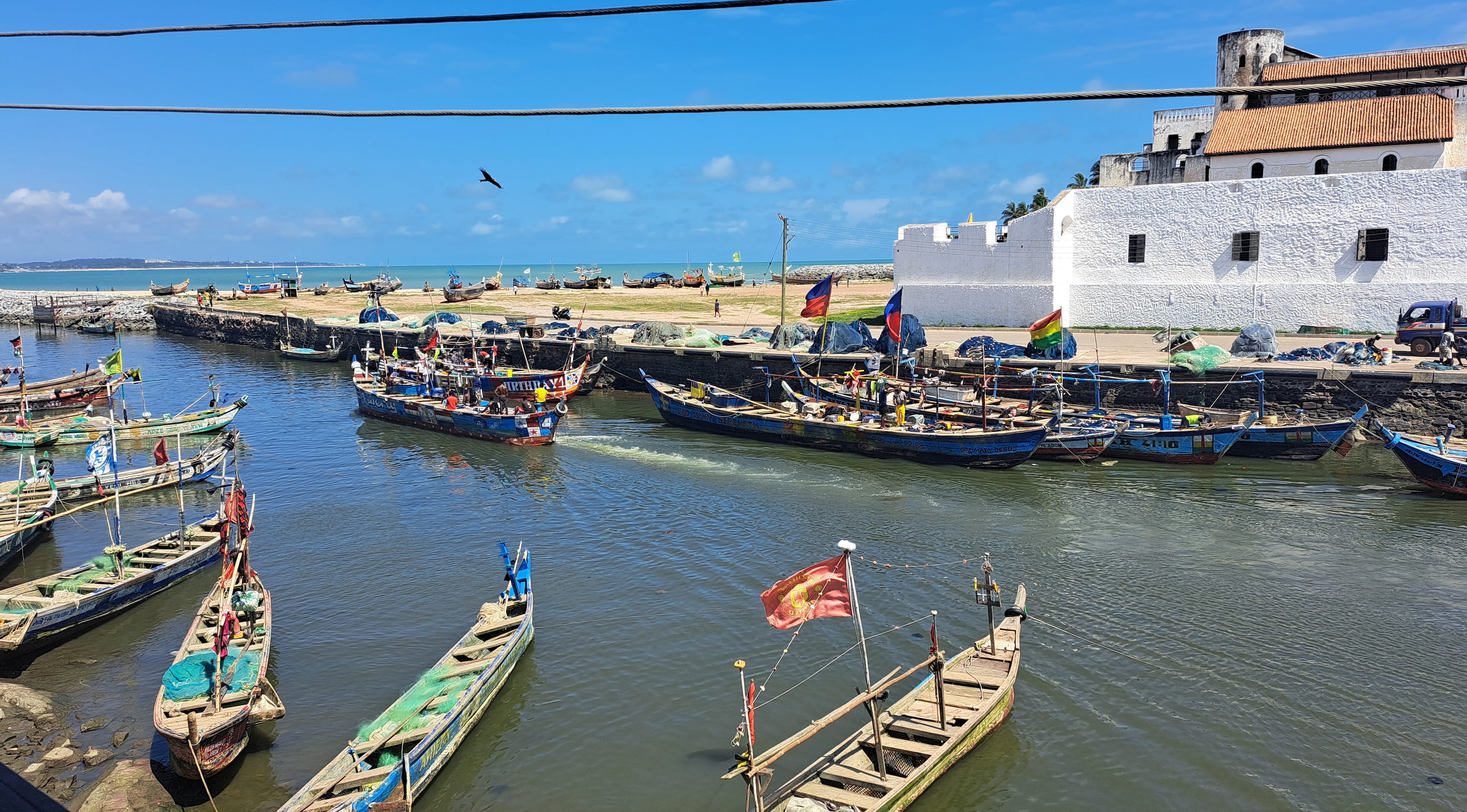
But beneath that layer, I am connected to coastal landscapes and mountainous terrains shaped by trade, migration, and resource extraction. The sea is central to my thinking because it holds memory. It holds both departure and return. My maternal grandfather was a seaman, so whenever I think about the sea, I think about him. I think about how my mother’s family migrated to Ghana.
The sea carries the residue of histories that were not always consensual. The coastline is not abstract for me. It is formative. That awareness also reminds me that land is never isolated. Even when I am physically in West Africa, I am not outside global currents. Conflicts far away reshape realities here. When I look at events such as the war between Israel and Gaza, or the geopolitical entanglements involving the United States, I see how those forces move through supply chains and energy markets.
In Ghana, those currents are very tangible. They affect oil prices, supply chains, and the broader energy sector. They determine whether electricity is stable, whether supply disruptions push us toward shortages, whether people worry about spending nights in darkness because something has shifted somewhere far away.
These global entanglements also shape diplomacy and politics. A statement by a president, a shift in alliances, a diplomatic posture — any of these can alter relationships between countries and create uncertainty. They ripple outward into economic conditions and into the emotional climate of daily life.
In Ghana, fuel prices shape everyday survival. They affect transport, food prices, and what ends up on people’s tables. They influence whether a family can afford a full meal or whether they rely on something as simple as gari and water.
“Global entanglements shape diplomacy and politics. They ripple outward into economic conditions and into the emotional climate of daily life. In Ghana, fuel prices shape everyday survival. They affect transport, food prices, and what ends up on people’s tables. They influence whether a family can afford a full meal or whether they rely on something as simple as gari and water.”
Beyond those material realities, global rhetoric also shapes the emotional atmosphere of the world. It determines the news we hear, the conversations we have in churches and offices, and the ways power is discussed, justified, or mourned. Coming from a region marked deeply by colonial borders and external interventions, I cannot watch conflicts elsewhere without recognizing certain patterns. The language of defense and retaliation, the narratives of security and entitlement. These frameworks are familiar even from a distance. Conflict changes the psychic atmosphere. It sharpens questions about belonging, dispossession, nationalism, faith, and survival. Questions that might once have felt distant suddenly become personal. A simple question like, “Where are you from?” can take on a new weight. It reminds me how easily land can become sacred and weaponized at the same time.
AS²: You know, sometimes I wonder whether it is really about the land itself, or about what can be extracted from it. Because if our concern were truly for the land, it would be difficult to justify an entire industry built on missiles, explosions, and destruction. The toxicity left behind — in the water, in the soil, in the air — suggests something else is driving it. Those forms of damage seem inseparable from the war economy. The exploitation of land and the machinery of conflict often move together.
BB: They do, they do. And of course, when I speak about land in this context, I’m using the term broadly. I mean everything connected to it — its extraction, its use, the economies built around it. It’s a wide frame. As both a poet and a lawyer, I can’t ignore that reality. I can’t ignore the violence carried out in the name of land, the violence done to the land itself, and the violence justified as necessary for it.
AS²: Yes. You know.
BB: That tension concerns me deeply. When we have these conversations, you could feel how emotional it is for me, you know?
AS²: Deeply, deeply. Last time I was there with you in your land, there was also the toxic waters movement happening.
BB: Yeah—illegal mining, what we call galamsey, exactly. The term comes from “gather them and sell.” That’s why I say land is really a continuum. Even though I’m in West Africa, whatever is happening elsewhere still affects us here, because in many ways the same dynamics are unfolding, just on a different scale or plane. The crisis of Galamsey shows that clearly. People fight over land and water bodies in the name of extracting gold. Rivers are poisoned, forests are cleared, and communities are destabilized. When I look at that, I can’t help but think about conflicts elsewhere where land is fought over through missiles and war. The forms look different, but the underlying logic is not so different. At the end of the day, the conflict keeps circling back to the environment — who controls it, who extracts from it, and who bears the cost.
AS²: Just to bring us toward a sense of conclusion today, and I know our relationship and these conversations will continue. First, I want to thank you for who you are, for joining this conversation, and for the work you are doing across so many fronts: as a culture maker, as an attorney, and as an advocate for land, sustainability, and for the rights and well-being of women and children in your region. In moments when things feel overwhelming, it’s important to remember that refusing to obey can also mean refusing to follow a broken analysis — refusing to repeat actions that we already know will produce harmful and non-generative outcomes.
Before we close, I’d like to ask if you have a final thought—perhaps a nourishing idea—that you would like to leave with us. Earlier, you spoke about the inheritance of peace as something that holds conflict, analysis, and survival all at once. If there is a single seed of an idea you’d like to leave us with, perhaps we can end there so that people have space to really hear it.
“I am naming ordinary actions as forms of resistance. Resistance to despair. Resistance to war. Because waking up is an act of consent to another day, even when the structures around you are flawed. Working is participation in survival. Writing is articulation rather than suppression. Loving deeply is a refusal to let hardness and pressure define who you are. And questioning is a form of intellectual integrity within systems that often discourage inquiry.”
BB: Yeah, definitely. I’ll end on this note: my inheritance of peace is the capacity to continue. Peace is often imagined as the absence of conflict. No argument. No visible disruption. But the lineage I come from understands peace differently. In our lives, peace has rarely meant ease. We did not inherit stable systems. We inherited colonial afterlives and gendered expectations. There was always something pressing in on my ancestors, and on me. And yet, despite all those pressures, they continued. They woke up. They went to work. They prayed. They cooked. They raised children. They carried grief quietly, without any theatrics. They adapted without surrendering themselves completely. That continuity — day after day, without spectacle — is what I think of as peace. And I don’t see it as passive. It is a form of strength that persists, even when the conditions around it are uncertain.
AS²: There you go.
BB: It is discipline. It is endurance. That is what peace looks like where I come from. So when I say that my inheritance of peace is to wake — to wake up, to go to work, to write, to love, to question — I am naming ordinary actions as forms of resistance. Resistance to despair. Resistance to war. Because waking up is an act of consent to another day, even when the structures around you are flawed. Working is participation in survival. Writing is articulation rather than suppression. Loving deeply is a refusal to let hardness and pressure define who you are. And questioning is a form of intellectual integrity within systems that often discourage inquiry. That is what I would call peace.
“Peace is not a gift handed down as comfort or luxury. It is something developed over time — like a muscle. It is the capacity to remain present to your life without surrendering to bitterness, without yielding to the violence of war, and without collapsing under the pressure of the times. It is forward movement without denying history.”
In my lineage, peace is not a gift handed down as comfort or luxury. It is something developed over time — like a muscle. It is the capacity to remain present to your life without surrendering to bitterness, without yielding to the violence of war, and without collapsing under the pressure of the times. It is forward movement without denying history. So my inheritance of peace is not calm waters. As my maternal grandmother used to say, it is the skill of navigating rough waters without capsizing. That, for me, is what my peace is.
AS²: Wow. Beautiful. Thank you so much for your presence in my life, and for taking the time to come on the podcast so that people who haven’t met you yet can hear you. I think these small alliances that cross obvious borders — of generation, of geography — are part of restructuring cultural life to something more planetary. Something grounded in understanding and care for one another.
BB: Yes, that’s true. I should thank you too, Amy. There’s a saying where I come from. It’s a playful variation on “birds of a feather flock together.” We say, birds of a feather confuse their owners. But really, what it means is that we recognize each other — we are of the same mind, working toward similar ideals and values.
Resources:
Human Rights Council Mid Term Report
“A Proclamation” , poem in Libretto Magazine.
Support Happy Monthlies Menstrual Education Organization
“Galamsey in Ghana: Mitigating its Negative Effects” by Felicia Dede Addy and Shikshya Adhikari
This interview has been edited and condensed. Listen to and follow Inheritance of Peace with Amy Shimshon-Santo on Apple Podcasts or substack at Warm Blooded Mammal With Hair. The music for this program is by Avila Santo.


